


Farmland
Farmland is tilled dirt made with a hoe — the only Minecraft block where wheat, carrots, potatoes, and beetroot grow.
Description
Block properties
| Item ID |
minecraft:farmland
|
|---|---|
| /give command |
/give @p minecraft:farmland
|
| Stackable | Yes (64) |
| Best tool | Shovel |
| Renewable | Yes |
| Hardness | 0.6 |
| Blast resistance | 0.6 |
Guide
How to Make and Use Farmland in Minecraft
-
1
Find water first
Locate or place a water source block where Farmland will sit within 4 blocks horizontally and at most 1 block below the water — Farmland needs hydration to stay tilled.
-
2
Pick a tillable block
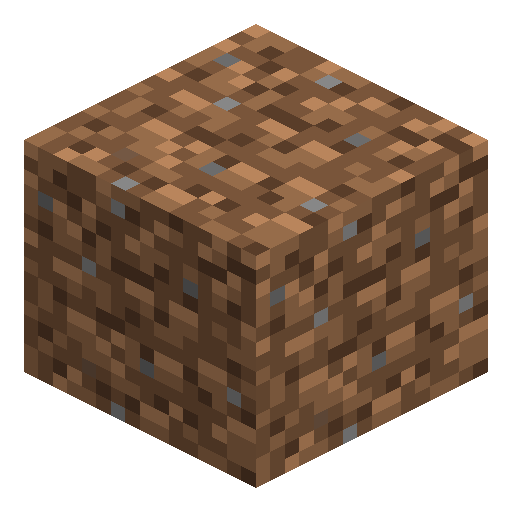
Stand on dirt, a grass block, or a dirt path — one hoe use creates Farmland; coarse dirt and rooted dirt turn to dirt first and need a second use, while podzol and mycelium cannot be tilled.
-
3
Right-click with a hoe
Equip any hoe (wooden, stone, iron, golden, diamond, or netherite) and right-click the block — the surface flips to Farmland with a tilling sound.
-
4
Plant a crop immediately
Place wheat seeds, carrots, potatoes, beetroot seeds, melon seeds, pumpkin seeds, torchflower seeds, or a pitcher pod on Farmland — empty, dry Farmland reverts to dirt over time.
-
5
Protect Farmland from trampling
Build a fence, slab cover, or 1-block wall around the plot — any mob or player that jumps or falls onto Farmland from above 0.5 blocks can revert it to dirt: the chance equals the fall distance minus 0.5, and walking never triggers it.
Bone meal speeds up the planted crop, not Farmland itself. Each neighboring hydrated Farmland block adds +0.75 to crop growth speed (dry neighbors only +0.25), while the same crop diagonally or across both axes halves the growth rate — plant in rows with gaps or alternate crops for the fastest growth.
How to craft this block




Frequently asked questions
How do you make Farmland in Minecraft?
Right-click dirt, a grass block, or a dirt path with a hoe — Farmland appears instantly with the tilling sound. Coarse dirt and rooted dirt first convert to regular dirt and need a second use, while podzol and mycelium cannot be tilled. Any tier of hoe works the same.
What can you plant on Farmland?
Farmland accepts wheat seeds, carrots, potatoes, beetroot seeds, melon seeds, pumpkin seeds, torchflower seeds, and pitcher pods. Sweet berries, sugar cane, bamboo, and nether crops do NOT need Farmland — they grow on other blocks.
How far can water hydrate Farmland?
A water source hydrates Farmland within 4 blocks horizontally and 1 block above. A single water block in a 9x9 plot covered with Farmland keeps the entire plot moist.
Why does Farmland turn back into dirt?
Farmland reverts to dirt for two reasons: it is dry with nothing planted, or a mob or player jumps or falls onto it from above 0.5 blocks — the trample chance equals the fall distance minus 0.5, and walking across never triggers it. The crop on top survives the trample and drops as an item.
Does bone meal work on Farmland?
Bone meal does not affect Farmland itself — it only accelerates the planted crop. Use bone meal directly on wheat, carrots, potatoes, or beetroot to skip growth stages.
Is Farmland the same in Java and Bedrock?
Almost: the tillable blocks, the 4-block hydration radius, the trample mechanic, and the 15/16 height are identical. One Java-only nuance: mobs smaller than 0.512 cubic blocks (chickens, rabbits, foxes) never trample Farmland in the Java Edition.
Minecraft and all related materials are trademarks and copyrights of Mojang Studios © 2009–2026. This site is not an official Minecraft product and is not affiliated with or endorsed by Mojang Studios or Microsoft Corporation.